
Setting a net-zero target just got more demanding: here's what to do first
If your company has a validated net-zero target, the Science Based Targets initiative (SBTi) just...
Two companies importing the same product, in the same month, can end up paying very different CBAM costs. The difference comes down to their data, not the regulation.
CBAM has moved fast in 2026 too. The definitive phase began in January, new benchmark rules landed in June, and a full ETS review followed in July, each one reshaping the picture for companies already mid-way through their first reporting cycle.
In this interview, Bart Verest and Sol González go through what's actually changed, what's still being decided, and, more importantly, where a company genuinely has room to influence its own CBAM cost, not the parts fixed by regulation, but the parts that come down to data quality, supplier engagement, and how early a company starts preparing.
Bart: In short, CBAM is basically kind of a passport control for embedded emissions. The purpose is to create a level playing field for products and goods that come into Europe, so they pay the same carbon cost as the products and goods that are produced within Europe itself. So that's the level playing field goal that they aim for. What they're also trying to do with CBAM is avoid carbon leakage. What we saw in the past is that some products and goods being produced in Europe paid the CO2 tax, while those produced outside Europe didn't, and that led to carbon emissions leakage to other countries. So the second goal, by creating a level playing field, is avoiding that leakage. Where an equivalent carbon price has already been paid in the country of origin, that amount is deducted from what’s owed under CBAM.
Bart: So, what we see in the daily reality with companies - the biggest challenge at this moment in time - is getting reliable emissions data. There's a kind of lack of verified data from their own suppliers; you need emissions data for the goods you import, and that has to come from your suppliers, whether that's energy suppliers or smaller vendors further down the chain, and it's very difficult to get reliable data from them. Part of that is a lack of data outright; part of it is that many suppliers are also unfamiliar with the EU’s specific calculation methodology and data quality requirements. In our own work with clients, we're also still seeing a more basic gap even before that: a lot of companies haven't yet completed a proper CBAM exposure screening to confirm which of their imports and suppliers are in scope. Getting that foundational step right early makes everything that follows – supplier engagement, data collection, third-party verification, and reporting – considerably more manageable.
Bart: The first and foremost step is identifying your suppliers from whom you buy goods that fall under CBAM. Most companies that fall under CBAM have already initiated that. The second step is to start engaging with those suppliers rather than waiting for reality to kick in. We've seen with clients that there's a real run-up needed to get to reliable emissions data, so we recommend engaging suppliers early and asking them for calculated embedded emissions data, ideally in a way where there's tracking and storing of proof of that information, because you might need it at a later stage. It’s also worth encouraging suppliers to run a readiness review or mock verification, so any gaps surface before an official inspection, rather than during one.
Bart: Yeah, since CBAM applies carbon taxation at the EU's outside borders, this only concerns electricity being imported into Europe from neighbouring European countries. Two good examples are the UK and Turkey. For the UK, import volumes are larger, but the carbon intensity of UK power isn't that different from Europe's. On top of that, UK electricity already carries a carbon cost under the UK ETS, so CBAM only requires you to pay the delta between the UK ETS price and the European emission cost. Turkey is different: without an equivalent emissions trading scheme or carbon tax in place, the CBAM cost runs considerably higher, which also reflects the character of that market.
Bart: Originally, indeed, it was raw materials that fell under CBAM. What they saw were some carbon leakage loopholes, and they now want to close those by expanding the scope into more downstream products. There'll be a significant increase in compliance obligations, because far more companies import downstream products than raw materials, so the group of companies being impacted is going to be much broader, both because the scope is wider and because more companies typically use processed goods than raw materials.
Keep in mind that, at this moment, there's no final list of products agreed yet. Further discussion is expected during the European Parliament's plenary session in September 2026, after which negotiations between the Parliament, Council and Commission will continue before anything is finalized. It's important to keep an eye on this as it develops. Practically, for a company importing finished or semi-finished products containing CBAM-covered materials, like steel or aluminium, they would need to identify and report the embedded emissions associated with those materials throughout their supply chains, not just the emissions of raw materials imported directly.
Bart: A benchmark in the ETS is essentially a reference to best-in-class levels (emissions intensity of the 10% most efficient installations). It pushes companies toward emission levels in line with the best-in-class production within Europe, and that's what drives free allocation. There's a direct relationship between the benchmark and the amount of free allocation handed out: the more free allocation, the more allowances are in the market, the less a company has to buy. That free allocation, in turn, has an impact on ETS prices as well. Even if a company doesn’t trade ETS allowances directly, this still matters because it affects how quickly carbon costs move through supply chains: as free allocation is reduced, EU producers pass more of that cost on to customers, while CBAM applies an equivalent cost to imports, so carbon costs become increasingly tied to supplier efficiency and emissions performance.
Sol: Before the 17 July proposal, there was also an implementing regulation adopted on 26 June this year that sets out the benchmarks for 52 products, plus two fallback benchmarks (Implementing Regulation (EU) 2026/1412). This matters because, on 17 July, there was a revision proposal to the heat and fuel benchmark based on the updated free allocation period, extended in the proposal to 2038 compared to 2034. Together, these two updates matter for CBAM because the EU ETS benchmarks are also used to calculate the CBAM adjustment for the remaining free allocation granted to EU producers, ensuring that imports and domestic production are treated consistently during the phase-out of free allocation.
In summary, CBAM cost exposure will be slightly reduced because the full certificate payments are being extended until 2038 instead of 2034. For companies, these changes are a key driver of future carbon cost scenarios and competitiveness assessments.
Bart: There's no direct, immediate impact; it's more of a long-term effect. Alongside the benchmark agreement, we also saw the ETS review on 17 July, and in that review the free allocation was extended further out. That means more free allocation, less of an obligation under CBAM in the near term, which leads to a less aggressive introduction path for CBAM. So, it's not immediate and direct; it's more of a longer-term impact.
The proposal now enters negotiations between the European Parliament and the Council before becoming law, with adoption expected during 2027.
Sol: The review in July was still a proposal, so it's now entering a negotiation phase between the European Parliament and the Council before it becomes formal law. Adoption is still expected in 2027, with negotiations and final assessments to be finalized by the last quarter of 2026. Free allowances and the CBAM benchmarks are two tracks that are different but closely connected.
So, changes to the ETS benchmark directly influence the level of carbon cost faced by producers, and indirectly the CBAM cost paid by companies importing products. The recent proposal of the 2026 benchmarks, alongside the updated free allowances, provides more certainty on allocation levels extended to 2038. This isn't really a contradiction or something different from before; it's just a timing issue. CBAM remains the long-term mechanism to align import carbon costs. But the key factor is how quickly that carbon cost gets transferred through supply chains, given that free allowances will be maintained longer than expected, to 2038 rather than 2034.
Sol: Calls to freeze the emissions trade system, or CBAM, are primarily an internal policy or competitiveness argument from industrial players rather than a legal proposal with broad legislative support. It isn't realistic to think it will be frozen completely, since any significant reform would require agreement from the EU institutions, the Council and the Commission, and is unlikely to modify CBAM's implementation at its core. Currently, the major discussions instead relate to authorizing delays, the 2038 extension compared to 2034, and some discussion on removing certain sectors, like fertilizers, given their link to food security regulations in the EU.
Sol: As a first step, companies should already be confirming which imported goods fall within the CBAM scope and which products are being impacted in their supply chain. That happens by validating the CN code classifications already published. They should also already be collecting supplier-level emissions data to compare against the default values already published. In Q1 2027, it will be important to start preparing for third-party verification, in case supplier emissions data is being used, and to establish a process to track and report the 2026 embedded emissions in order to forecast the carbon price that will be paid under CBAM by September 2027 at the latest. These activities are already confirmed by the regulations and are unlikely to change significantly. What companies should avoid is putting too much weight on long-term cost forecasts based on today's free allocation trajectory, since the proposals are still under negotiation and the 2038 extension isn't final. What won't change is the need for reliable emissions data, supplier engagement programmes, and the other activities companies should already be doing regardless.
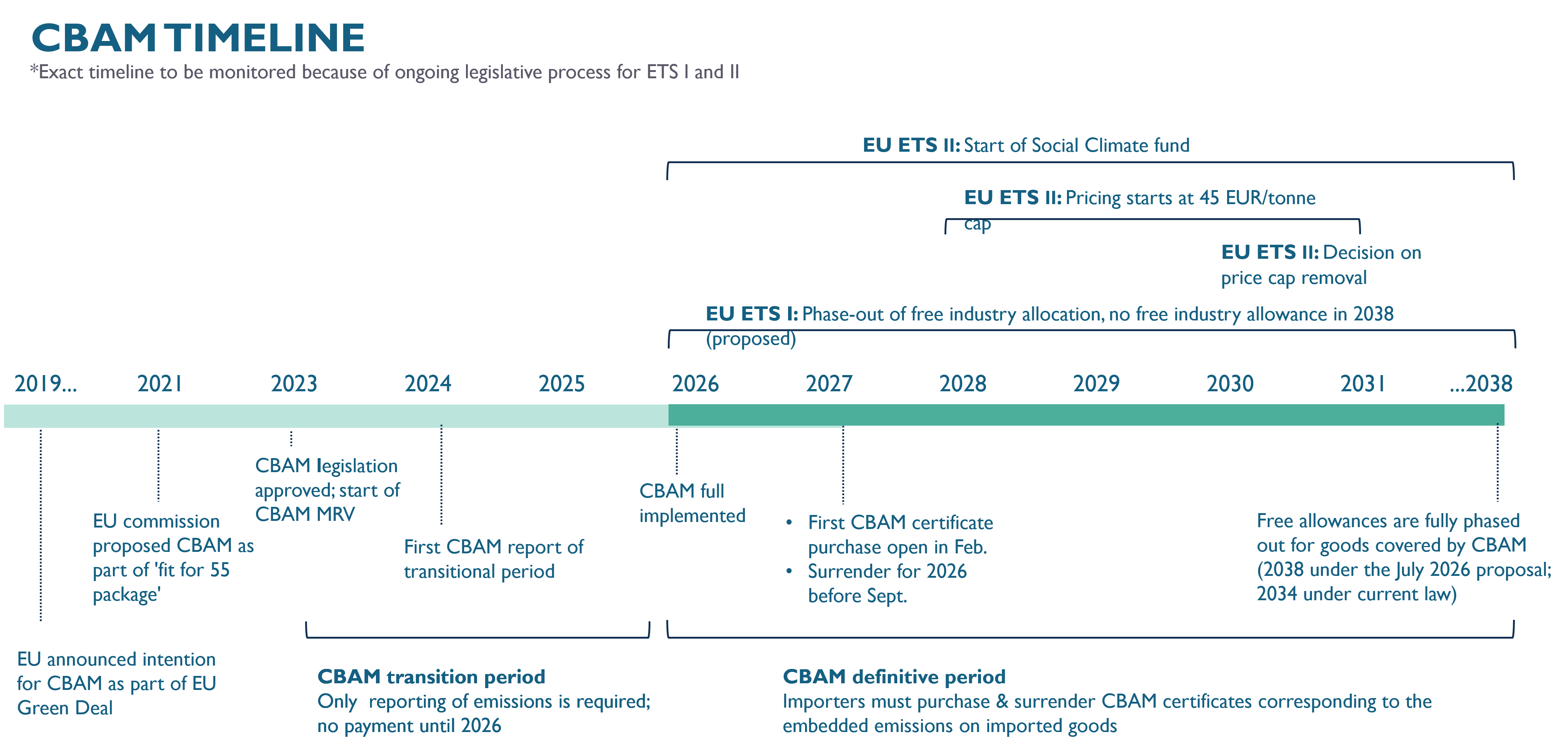
Sol: The biggest misconception is that CBAM is a tax companies can't control, when actually there's a clear pathway showing CBAM is an extension of Europe's carbon pricing system. Companies do have a degree of control over how much they pay for CBAM certificates. Importers won't pay a fixed tariff; they'll pay the carbon cost linked to the verified embedded emissions of the imported products. So any adjustment to primary data, any improvement in efficiency in how products are produced, any work done with the supply chain to improve decarbonization in their supply chain, will genuinely affect the CBAM cost a company faces in future. Companies should be collecting this data now, verifying it with authorized verifiers, and working on how to make their claims more efficient and their costs lower.
Sol: The most significant decision is the replacement of the free allocation period. The negotiations to extend it to 2038 will reduce CBAM costs during the transition period for both European manufacturers and importers, reducing the long-term cost companies will be paying under CBAM. The next major phase will be the last quarter of 2026, when the European Parliament and the Council will be reviewing this extension proposal, while CBAM implementation itself continues as planned for 2026 emissions reporting and certificate payments in 2027. The expansion of CBAM to other products is also relevant and expected to be discussed in 2027, for implementation in 2028, bringing more importers into scope, particularly in sectors like steel, aluminium and cement. In summary, the practical message is that 2026 is a preparation year, gathering data and working with the supply chain on embedded emissions reporting, while 2027 is the year CBAM obligations properly start applying and the rules for reporting and certificate payments take shape.
Want to go deeper on CBAM? Look out for our webinar in September. Registration will open soon - keep an eye on our LinkedIn page so you don't miss out.
For background on how the mechanism works, see our earlier explainer on CBAM's pilot phase: CBAM: first step to avoid carbon leakage